Type SYNTH


Next: Type VALSYNTH
Up: Guiões de Interacção
Previous: Type DECISION
The Declarations Component includes also the declarations of:
- the arguments of the operation to invoke (ARGS);
- the variables of the Presentation used (STATE-UI).
The Behaviour Component includes also the declaration of:
- conditions to be verified and actions to be executed after each event (TRANS);
- actions to execute in the start of the GI (INIT);
- the operation to invoke (EXEC).
For reasons that have to do with semantic consistency only in the EXEC clause of this type of GI may we invoke an operation that changes the state of the application.
For writing EVSEQ their are also the operators:
-
 - sequence;
- | - syncronous paralellism, both dialogues can happen in parallel the global dialogue is finished when one of them is.
- || - assyncronous paralellism, both dialogues can happen in parallel the global dialogue is finished when both are.
Their are some predefined actions that can be included in TRANS:
- OK - when present the GI only ends when the action is selected, this action is only available when EXEC is redy for execution;
- CANCEL - this action is always available (when present in TRANS) and ends the GI without invoking EXEC;
- APPLY - similar to OK but the dialogue is restarted;
- RESET - similar to CANCEL but the dialogue is restarted.
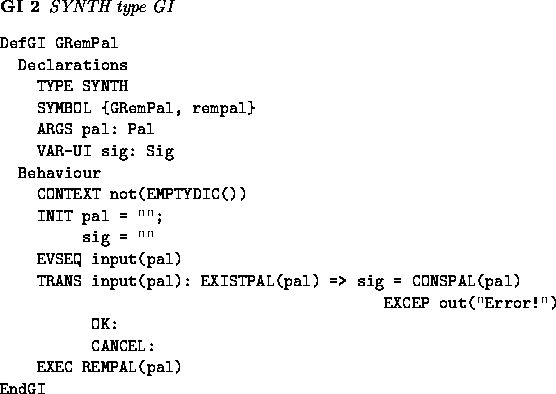
In GI 2 the GI GremPal specifies the synthesis of the call of the operation REMPAL.
We can see that this synthesis is valid only if the condition "not(EMPTYDIC())" holds (cf. CONTEXT clause).
After reading pal, if "EXISTPAL(pal)" is true then "sig = CONSPAL(pal)" is executed else an error message is shown (cf. TRANS clause for input(pal)).
Jose Franscisco Creissac Campos
Wed Jan 31 21:20:05 MET 1996